
Birthday
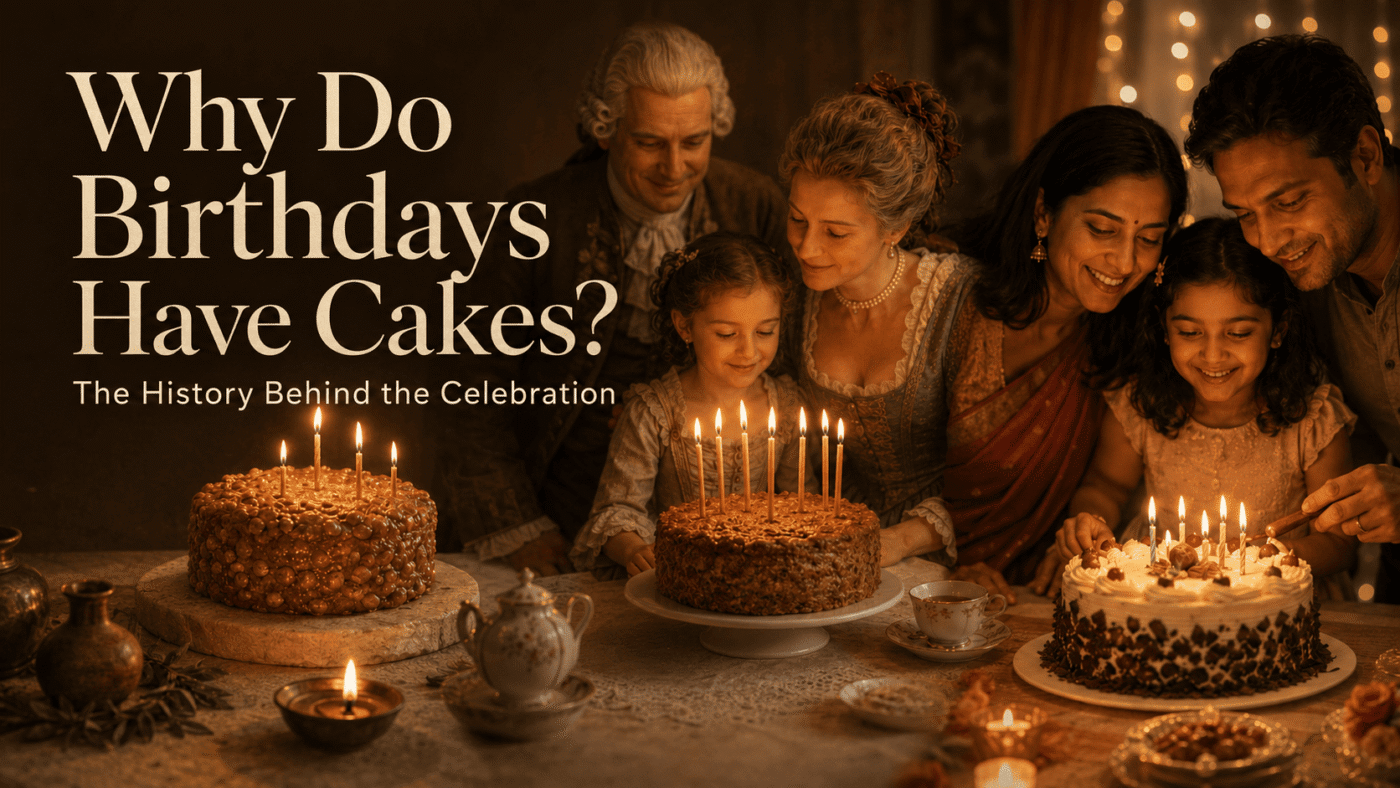
Why Do Birthdays Have Cakes? The History Behind the Celebration
Jul
Think of a birthday celebration and one scene probably comes to mind: a cake arrives, candles are lit, everyone begins singing, and the birthday person makes a wish before cutting the first slice.
This custom feels so familiar that few people stop to question it. Why do we celebrate birthdays with cake instead of another dessert? Who introduced birthday candles? And how did the same basic ritual become popular in countries with very different food traditions?
There is no single inventor of the birthday cake. The celebration we recognise today developed gradually as religious customs, European children’s celebrations, advances in baking and family traditions came together.
The Short Answer
Birthday cakes became popular because several traditions eventually combined:
- Sweetened breads and cakes were already associated with special occasions.
- German families began placing age-related candles on children’s birthday cakes.
- Sugar, flour and baking equipment became more accessible.
- A decorated cake could carry a name, age or personal message.
- Cake was easy to divide and share with a group.
- Singing, wishing and cutting created a simple ritual in which everyone could participate.
The modern birthday cake was therefore not invented at one particular time. It evolved over several centuries.
Did Birthday Cakes Begin in Ancient Greece?
Ancient Greece is frequently described as the birthplace of the birthday cake, but that explanation needs some qualification.
The ancient Greeks prepared cakes sweetened with honey and offered them during religious ceremonies. During festivals honouring Artemis, a goddess associated with the moon, worshippers presented round cakes accompanied by lighted torches or candles. The circular shape and surrounding light may have represented the moon.
This sounds similar to a modern candlelit cake, but it was not a personal birthday party as we understand one today. These cakes were religious offerings rather than decorated desserts prepared for family members.
The Greek custom may have contributed some of the symbolism later associated with candlelight, wishes and celebration. However, there is no clear historical line connecting those ceremonies directly to today’s birthday parties.
Ancient Greece provides a possible influence, not a confirmed starting point.
Germany Gave the Tradition a Familiar Form
A clearer connection appeared in Germany during the 18th century.
German families celebrated children’s birthdays through a custom commonly called Kinderfest, meaning a children’s festival. A cake was prepared for the child, and candles were placed on it to represent their age.
Some versions included an additional candle symbolising hope, good luck or another year of life. This is sometimes described as the “light of life.”
The candles might remain lit during part of the celebration before the child attempted to blow them out. This arrangement is much closer to the birthday ritual followed today.
A written account from 1746 describes an exceptionally large cake prepared for Count Ludwig von Zinzendorf. The cake reportedly contained candles corresponding to his age, along with an additional candle. Later European accounts also describe illuminated cakes at birthday celebrations.
These records do not prove that Germany invented every part of the custom. They do, however, provide some of the earliest clear evidence of age-related candles being placed on a celebration cake.
Cakes Were Once a Sign of Wealth
Early celebration cakes were quite different from the light sponge cakes covered with cream that are common today.
Producing a rich cake required refined flour, sugar, eggs, butter, dried fruit and suitable baking equipment. Several of these ingredients were expensive or difficult for ordinary families to obtain. Baking also required enough fuel and an oven capable of maintaining a reasonably controlled temperature.
As a result, elaborate cakes were mainly prepared by wealthy households or professional bakers. Simpler sweet breads and homemade desserts were more practical for most families.
A decorated cake felt special partly because it was not an everyday food. Serving one showed that the occasion was important enough to justify additional time, ingredients and expense.
How Birthday Cakes Became More Affordable
During the 18th and 19th centuries, improvements in food production gradually made cakes accessible to more people.
Sugar became more widely available, flour processing improved, and chemical raising agents made it easier to produce lighter cakes. Domestic ovens also became more practical and reliable. As cities expanded, commercial bakeries could prepare cakes for customers who did not have the time, ingredients or equipment to bake at home.
These changes did not make decorated cakes affordable to everyone immediately. The transition happened gradually.
By the late 19th and early 20th centuries, families in Europe and North America increasingly treated a birthday cake as an expected part of a child’s celebration.
| Period | Development in the birthday cake tradition |
|---|---|
| Ancient world | Sweetened breads and cakes were used during religious festivals and important occasions. |
| Ancient Greece | Lighted ceremonial cakes were associated with the worship of Artemis. |
| 18th-century Germany | Cakes with age-related candles appeared in children’s birthday celebrations. |
| 18th–19th centuries | Improved ovens and more accessible ingredients made baking easier. |
| Late 19th century | Candle blowing and family birthday parties became more widely documented. |
| Early 20th century | The familiar birthday song, candles and decorated cakes spread together. |
| Modern era | Local flavours, personalised designs and new cake styles transformed the tradition. |
Why Are Candles Placed on Birthday Cakes?
The most practical purpose of birthday candles is to represent age. Before numbered candles became common, families could place one candle for every completed year.
Light also carries positive meanings across many cultures. It may represent life, hope, protection, knowledge or the beginning of another year. A glowing candle therefore fits naturally with an occasion centred on someone’s life.
The practice of making a wish is more difficult to trace.
One theory connects it with the old belief that rising smoke could carry prayers or messages towards the heavens. Another possibility is that wishing developed later as a playful addition to children’s birthday celebrations.
The familiar rule that a birthday wish must remain secret probably does not have one historical source. It is better understood as part of the mystery and anticipation surrounding the moment.
How Blowing Out Candles Became a Complete Ritual
Without candles, cake would simply be another dessert served after a meal. The candles created a sequence in which everyone could participate:
- The cake enters the room.
- Family members and guests gather around.
- The candles are lit.
- Everyone sings together.
- The birthday person makes a wish.
- The candles are blown out.
- The cake is cut and shared.
This short sequence gives the celebration a clear centre. Guests know when to gather, what to sing and when to take photographs. The birthday person receives everyone’s attention without having to organise a performance or deliver a speech.
Research discussed by the Smithsonian suggests that rituals can increase anticipation and may even make the food that follows feel more enjoyable. This helps explain why the cake-cutting moment can feel significant even when the cake itself is simple.
Where Did the “Happy Birthday” Song Come From?
The familiar birthday song was not originally written for birthday parties.
Its melody came from an American classroom song called “Good Morning to All,” published in 1893 and associated with sisters Patty and Mildred Hill. The birthday lyrics appeared later and became widely known during the early 20th century.
As the song spread through schools, homes, films and public celebrations, it joined the existing cake-and-candle tradition. Together, they created the birthday scene that remains familiar today.
The song also became the subject of a lengthy copyright dispute. In 2015, a United States court found that the company claiming ownership did not hold a valid copyright over the lyrics, allowing the familiar version to be treated as part of the public domain.
Why Cake Instead of Another Sweet?
Cake has several practical qualities that make it particularly suitable for a birthday.
It can be shared easily
One cake can be divided among family members, friends or colleagues. Sharing slices allows every guest to receive a small part of the celebration’s main attraction.
It can carry a personal message
A name, age or short birthday wish can be written directly on the cake. Few other foods work so naturally as both a dessert and a personalised greeting.
It creates a visual centrepiece
A decorated cake immediately communicates the purpose of the gathering. Its design can reflect the person’s age, hobbies, interests or favourite colours.
It can be personalised
A cake does not need to follow one fixed design. Today’s designer cakes may be based on professions, sports, hobbies, cartoons, travel or personal memories.
A photo cake can also turn a family photograph or memorable image into the centre of the celebration.
It can accommodate different preferences
Cake recipes can be adapted for different flavours and dietary requirements. The widespread availability of eggless cakes is one example of how the tradition has adjusted to local needs.
How the Birthday Cake Tradition Developed in India
India had strong traditions of celebrating important occasions with sweets long before Western-style birthday cakes became popular. Mithai such as laddoo, barfi, peda and halwa were—and remain—closely connected with festivals, family milestones and good news.
European-style baking expanded in India through colonial-era bakeries, hotels, clubs and Christian communities with established baking traditions. As commercial bakeries spread through cities, sponge cakes and cream cakes became increasingly familiar to urban families.
Over time, cake cutting joined Indian birthday celebrations without completely replacing traditional sweets. Many families now serve both cake and mithai.
Indian celebrations also developed their own customs. The birthday person may feed the first piece to their parents, spouse, children or closest friends. Guests may then feed small pieces back to the birthday person. This turns cake cutting into an exchange involving the entire family rather than simply the serving of dessert.
Indian preferences have also changed the cake itself. Popular choices now include chocolate, butterscotch, pineapple, mango, rasmalai and fusion flavours inspired by traditional sweets. Families planning a celebration can find these familiar flavours through local bakeries and services offering cake delivery in Delhi, subject to the selected design, location, delivery date and available time slot.
Birthday Cakes Today Are About Personal Identity
Modern birthday cakes do more than display a person’s age. Their design can communicate something about the individual being celebrated.
A child may want an animal, princess or superhero theme. A sports fan might receive a cricket or football cake. An adult may prefer a minimalist design, a humorous message or a cake based on travel, fitness or work.
Social media has also changed expectations. Cakes are now frequently designed with photographs and videos in mind. Colour combinations, toppers and decorations may be chosen partly for how they will appear on a phone screen.
However, a memorable birthday does not require a large or complicated cake. Cupcakes, homemade cakes, cheesecakes and traditional Indian sweets can perform the same role. The purpose is to create a shared moment, not to produce the most expensive decoration.
Frequently Asked Questions
Who invented the birthday cake?
No single person invented it. The modern birthday cake developed from several older customs, with particularly clear evidence coming from 18th-century German birthday celebrations.
Were the first birthday cakes made in ancient Greece?
Ancient Greeks prepared ceremonial cakes associated with Artemis, sometimes accompanied by light. These may have influenced later symbolism, but they were not modern personal birthday cakes.
Why do we put one candle on the cake for every year?
Candles were used to represent the birthday person’s completed years. Some German celebrations also included an extra candle for hope, luck or the year ahead.
Why do people make a wish before blowing out candles?
The exact origin is uncertain. The practice may be connected with older beliefs about smoke carrying prayers, or it may have developed as a playful part of children’s celebrations.
When did birthday cakes become affordable?
Cakes became more widely accessible during the 18th and 19th centuries as ingredients, ovens, raising agents and commercial baking improved. The change happened gradually rather than in one particular year.
Is a cake necessary for a birthday celebration?
No. Cake is a popular convention, not a requirement. Mithai, fruit, cupcakes or another meaningful food can serve the same purpose.
A Tradition Built Over Time
Birthday cake did not begin with one baker, one country or one carefully planned invention. It emerged as different customs came together: ceremonial sweets, candlelight, German children’s celebrations, improved baking and the desire to mark another year of life.
Its lasting appeal is not simply that cake tastes good. The cake gives people something to gather around. The candles create anticipation, the song involves the whole group, and sharing the slices brings the moment to a natural close.
That combination turned an occasional luxury into one of the world’s most recognisable celebration traditions.
